Two checks for a healthy head: the electrical head check and the printed nozzle check
In single-pass printing there is no second pass to hide a missing nozzle: one nozzle that does not fire draws a white line through every label. Two different checks find two different kinds of fault, and a production line needs both.
The electrical head check — no print needed
SmartPrint G5 measures the current that drives the head's piezo elements. In the head check each row is fired three times for half a second: with no nozzle selected, with every nozzle selected, and with only the nozzles in the data the board sent. From the current the board reports, per row and in plain words, a row that is not connected, a partly connected row, a short, or a fault in the data path to the head. Nothing is ejected that a normal spit would not eject.
What it cannot find: a clogged nozzle. A clogged nozzle takes the same charge as a good one.
The printed nozzle check — the clogs
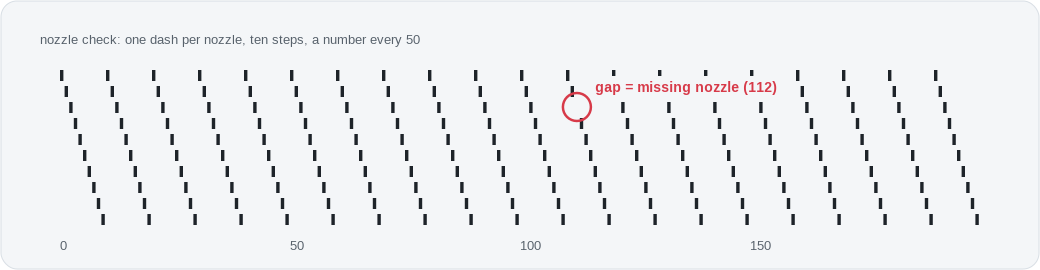
A nozzle check prints one dash for every nozzle across the head, in a staircase of ten steps with a number every 50. A nozzle that does not fire leaves a gap in the staircase; its number is read off the print by counting from the nearest number.
What to do with a missing nozzle
Clean the head and check again. If a gap remains, SP_app keeps a list of missing nozzles: from then on a job whose barcode crosses a missing nozzle does not start, because a white line through a code makes it unreadable. Move the code in the design, or clean again, and clear the list after a check with no gaps.
A routine that works
At the start of a shift: spit, then print a nozzle check. After a long stop: spit before printing. After a head change, a cable change or an unexplained fault: run the electrical head check. The two checks take a minute together and catch both kinds of fault before they reach the customer's labels.